

Advances in automation, cloud computing, robotics, and artificial intelligence (AI) have spurred the adoption of new technologies across government agencies. In particular, robotic process automation (RPA) has exploded in growth because of its easy integration with other systems, user-friendly functionality, and applicability to mundane tasks across various departments.
The explosion of interest in RPA began in organizations that handle a high volume of transactions like banking and claims processing. In a recent NASCIO article, 29 percent of state leaders aim to optimize processes or functions, while 21 percent want to automate processes or functions typically done by staff. 1
What is robotic process automation (RPA)?
Robotic process automation (RPA) is a software technology that allows people to create automated workflows to handle the repetitive, mundane tasks a human would traditionally complete. Software robots use detailed automation scripts to navigate software applications as a human would (with a keyboard and a mouse) and access systems through application program interfaces (API), integrated connectors, or direct function calls.
RPA software tools include the following core functionalities:
- Low code capabilities for automation script building
- Integration with enterprise applications
- Orchestration, administration, configuration, monitoring, and security capabilities
Where is RPA useful?
Agencies across the public sector are deploying RPA as a tactical solution to improve operational efficiency. Rates of adoption are highest in functions like customer relationship management (in which chatbots and digital assistants are proving to be valuable), compliance, finance (Accounts Payable), permitting, and other citizen facing services. Recently, organizations have started using RPA with machine learning and artificial intelligence to add value to data-driven decision-making.
Where is RPA happening?
Change is evident in agencies using RPA to automate tasks. As RPA usage grows across the enterprise, new benefits are being realized in areas including general administration, health and human services, education, transportation, and others.
Early automation focused on explicit steps within larger processes. Now, the combination of technological advancements in RPA, and the growing trust among agency stakeholders who had success handing off work to robots, has created a push for more end-to-end process automation. Legacy systems and processes are a prime example.
In the US, more than 58% of citizen-related processes are on paper.2 Because of this, backlogs are frequent and limited staff are available to respond. By deploying RPA, agency staff can eliminate the need to focus on antiquated processes and spend more time on strategic initiatives and responding to citizen needs.
Key industry drivers for RPA
The growth of RPA is driven by several forces, including:
- A proven track record for providing up to 80% cost efficiency, according to UiPath.3
- Increased accuracy through “rule follow” coding; better compliance and consistency in processing (along with easy audibility of results)
- The ability to relieve staff from mundane and repetitive work so they can take on higher-order job responsibilities requiring cognitive abilities
- Reduction in cost of RPA as service providers reach economies of scale and offer more cloud-based subscription offerings, increased ROI, and reduced average price-per-seat
What are the key features and benefits of RPA?
RPA offers the following benefits to government agencies:
- Improved citizen services delivery
- Seamless integration with an external system for data capture and entry
- Streamlined execution of the automated rule-based framework
- Ability to minimize manual/paper-based work
- Real-time, cross-platform work with reduced overlap and miscommunication
- Reduced cost
- Increased productivity
Government process automation entry points
Here, in Figure 1, we’ve picked out a list of the processes across government agencies that are highly suited to RPA. Though the listing is not comprehensive, it provides a good selection of sub-processes that can be explored by any agency looking to begin RPA-led digital transformation.
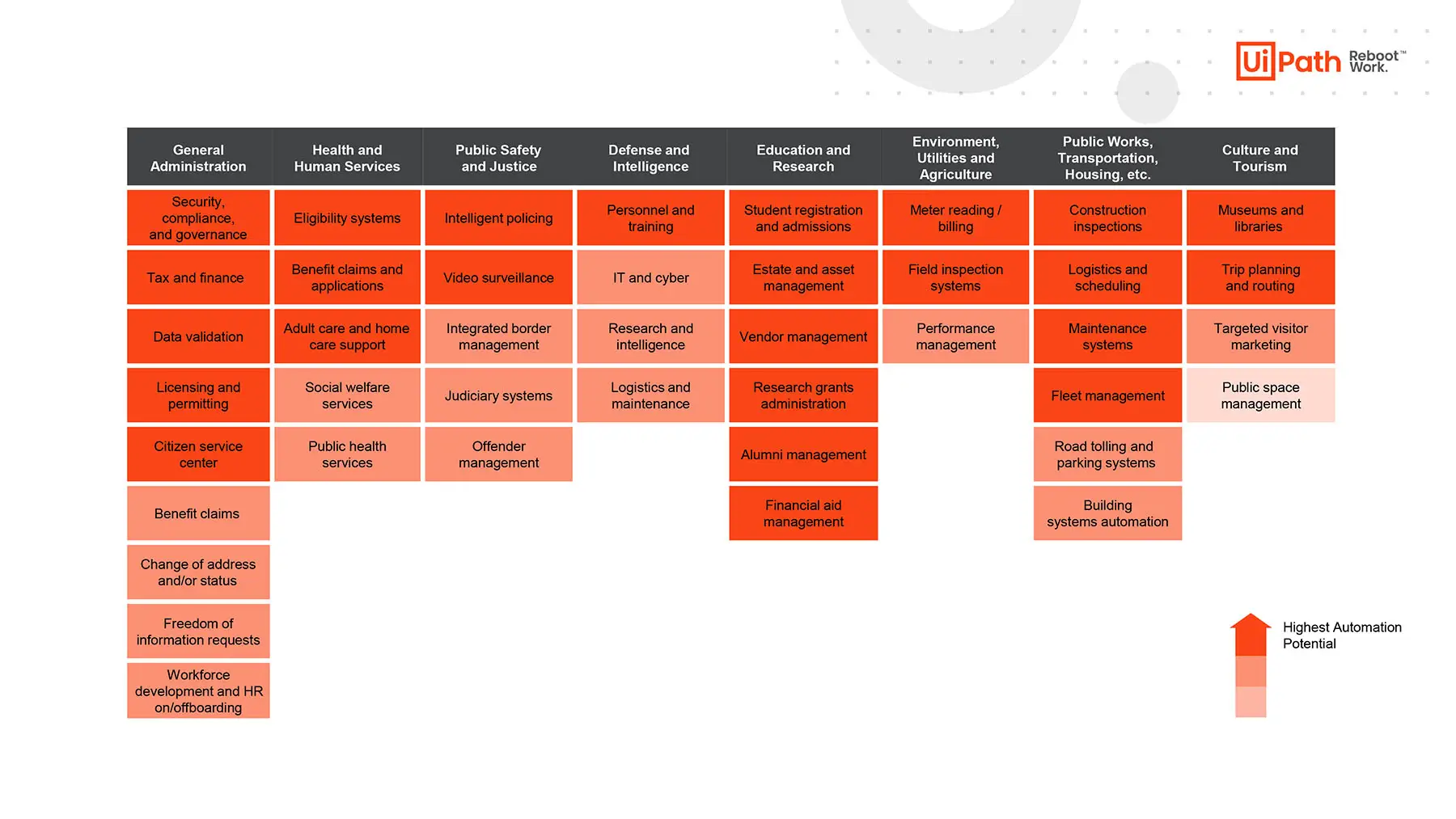
Figure 1: UiPath
The future outlook for RPA
While the adoption of RPA is still only building momentum, the interest and conversation around it will continue. It’s likely that more agencies will leverage savings from early RPA successes to invest in complementary technologies, like intelligent character recognition and cognitive decision support. Major RPA platforms will continue to enhance technical capabilities to expand the processes that can be successfully accomplished by robots.
CAI helps state and local government agencies prepare for and implement RPA so they can achieve their goals, save costs, and reallocate labor to strategic initiatives. We partner with the world's leading RPA software company, UiPath, to help your agency use automation to improve productivity and accuracy and ensure a strong return on investment. Contact us to discover how automation can help improve your citizen and staff experience.

Endnotes
- “Ai Meets the Moment: How a Pandemic Has Shaped AI Adoption in State Government and What It Means for the Future.” NASCIO, October 26, 2021. https://www.nascio.org/resource-center/resources/ai-meets-the-moment. ↩
- “Robotic Process Automation (RPA) for the Public Sector - Uipath.” UiPath, 2019. https://www.uipath.com/hubfs/resources/documents/PDFs/UiPath%20Ui_190484_2-page%20Government%20Brochure-05-lm.pdf. ↩
- “Robotic Process Automation ( RPA ) for Every Industry.” UiPath. https://www.uipath.com/automation/rpa-essentials. ↩
- Figure 1: https://www.uipath.com/ ↩