
How local governments can approach the hyperscale data center craze
Let me take you back to 1979. In the small city of Middletown, PA, the nuclear plant there experienced a partial meltdown of unit 2. This came to be known as the Three Mile Island (TMI) accident, and it was the largest release of radioactive material in U.S. history at the time. Cleanup started in August 1979 and officially ended in December 1993. The total cost of this cleanup was about $1 billion (the equivalent of $2 billion in 2024). Unit 1 restarted in 1985 but was then retired in 2019 due to operating losses.
Why do I remember this so well? I attended college nearby and started my professional career in Harrisburg. For years, we kept a packet of potassium iodine tablets in desk drawers as an emergency safety precaution. Times are different now. Technological advances, as well as safety measures, have greatly improved.
Fast forward to the summer of 2025—Microsoft entered into a contract to revitalize Three Mile Island as part of a wave of building hyper-datacenters. What spurred this? The explosion of artificial intelligence (AI) technology.
As we all are seeing, the AI-driven data center boom is one of the biggest infrastructure stories in the U.S. right now. However, the receptiveness of this growth is mixed. This article will provide a breakdown of the who, what, where, why, and when, based on the latest data and developments as of early 2026. The goal is to understand varying perspectives associated with data centers, and to raise awareness and increase knowledge for informed decision-making.
What is a hyperscale data center?
Data centers are large buildings that house rows of computer servers, data storage systems and networking equipment, as well as the power and cooling systems that keep them running. This infrastructure is essential in providing instantaneous digital services, such as email, streaming video, saving documents to the cloud, etc.
Hyperscale data centers go one step further to handle AI requirements and related product growth. These facilities consume enormous amounts of electricity (for computing) and water (for cooling servers), and are being built at an unprecedented rate. A single, large AI-focused center can use as much power as 100,000+ homes and millions of gallons of water daily. U.S. data centers already account for about 4 percent of national electricity and are projected to reach 9 to12 percent by 2030. Water use is also surging, with hyperscalers alone potentially consuming 16 to 33 billion gallons annually by 2028.1
Major technology firms, including Microsoft, Google, Amazon (AWS), Meta, and OpenAI, are contributing to the explosion of generative AI which requires vastly more computing power than traditional cloud services. The hyperscale data centers are optimized for graphical processing (GPU) heavy AI workloads. This has created a "gold rush" for capacity, with technology companies racing to secure power, land, and cooling before shortages impede growth.
Where are hyperscale data centers being built?
The traditional hub for hyperscale data centers has been centered in Northern Virginia, often referred to as "Data Center Alley".2 However, attention is being shifted to areas where development is less expensive and (depending on the geography) power and water needs are more easily met.
Key growth hotspots from 2025 data include Virginia with 663 operational and 595 planned/under construction; Texas with 405 operational and 442 planned; California with 319 operational, and Georgia with 162 operational and 285 planned .3
Here are visual overviews of the current U.S. data center landscape:
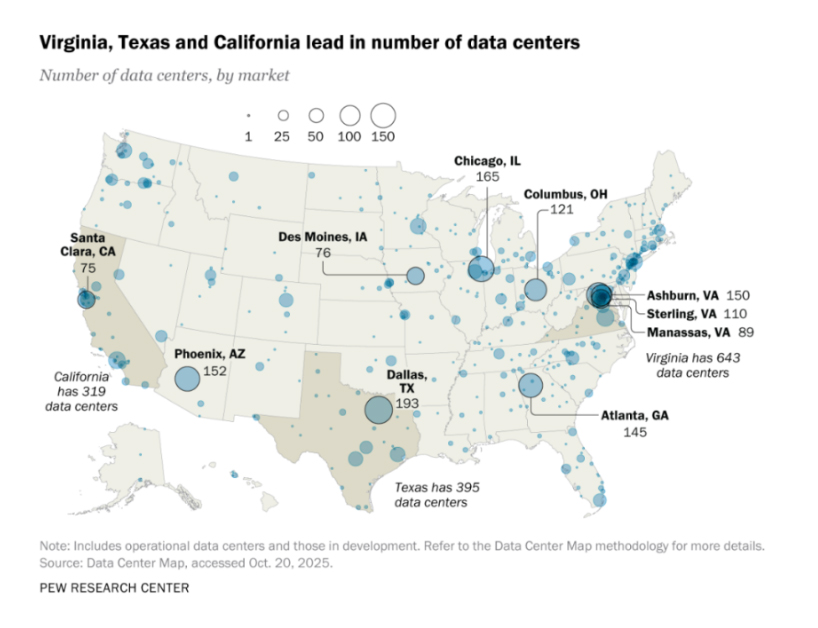
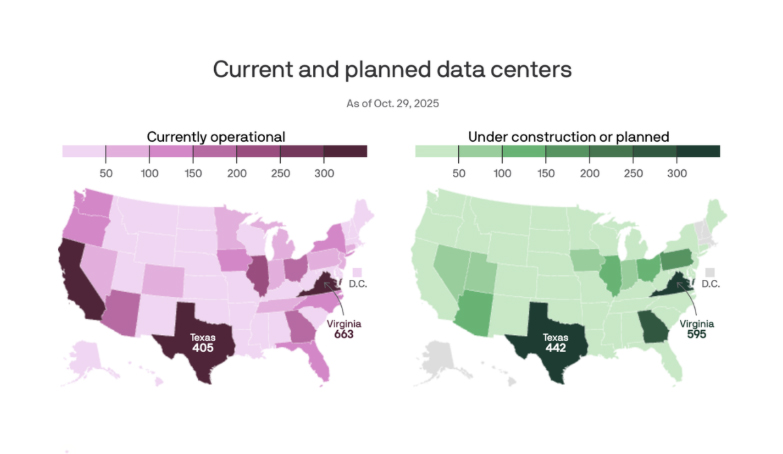
Throughout 2025, there have been record announcements, with many of those large projects scheduled to come online during 2026-2028. What we expect is that by 2030, the energy demand from hyperscale data centers could more than double again.4
How are counties responding to hyperscale data center construction?
Counties are caught in the crosshairs. On one hand, hyperscale data centers bring new tax revenue that could enable resident tax cuts or increase opportunities to contribute to local infrastructure, like building new schools and health centers. On the other hand, data centers also create real strains on power grids, water supplies, noise, traffic, and residential quality of life. In addition, while construction requires an increase in hirings, there isn’t a large uptick in jobs once construction is complete.
The responses are mixed. Over 35 states have tax breaks and incentives in place. However, through public concern and meetings, restrictions and even moratoriums are growing. The backlash has included the denial or delay of permits. This is leading to stricter zoning (special-use permits, public hearings, industrial-only zones, noise/water rules).5
Recent notable examples include:
- Loudoun & Henrico Counties (VA) ended "by-right" approval given automatically under existing zoning rules, now require public hearings and special permits6
- Multiple Georgia counties/cities (DeKalb, Clayton, Pike, etc.) implemented moratoriums or strict new ordinances7
- Maricopa County (AZ) limited to heavy industrial zones8
- Other pushback: Projects withdrawn/delayed in Ohio, Indiana, North Carolina, etc., over electricity bills, water, and grid strain.9 The Pennsylvania Governor is proposing Governor’s Responsible Infrastructure Development (aka GRID) standards, which includes four principles for the build of data centers10
It’s clear that AI is forcing a massive, rapid infrastructure build-out that's reshaping local economies and politics. Some local government entities are moving forward, while others are pushing back hard as residents present the downsides. The hyperscale data center trend is still strongly upward, but local resistance is creating real friction in many places.
What should counties do now about hyperscale data centers?
Counties facing the AI-driven data center surge are at a critical decision point in early 2026. The boom is not slowing. Hyperscale data center providers continue announcing massive projects, while at the same time, local resistance, grid strain, water limits, noise complaints, and quality-of-life concerns are growing rapidly.
Here are realistic paths counties can take, ranked roughly from most proactive to most welcoming, with what each approach typically involves and the trade-offs.
-
Pause everything temporarily (most common immediate action in 2025–2026)
Many counties are imposing moratoriums (usually 6–12 months, sometimes longer) to buy time. This looks like:
- Halting new applications, rezonings, permits, or approvals for data centers (or large-scale ones above a certain megawatt threshold)
- Using the time to study impacts, update comprehensive plans, draft ordinances, hold town halls, consult utilities, and gather community input
- Examples:
- DeKalb County (GA) extended the moratorium to June 202611
- Clayton, Pike, Lamar, Troup, Gordon Counties (GA) implemented 60–180-day moratoriums in late 2025/early 202612
- Madison (WI), Prince George's County (MD), Harvey County (KS), others implemented 6–12-month pauses13
- Oklahoma and New York are considering legislation to pause data center construction14
Choosing this strategy avoids rushed bad decisions, improves the accuracy of usage projections, lets residents speak, and gives time to negotiate better terms or block poor sites entirely. The trade-off is developers may walk away to faster-moving counties, which can create a perception of being "anti-business."
-
Move from "by-right" to requiring public review and special/conditional use permits
This is the most widespread tightening among counties that still want some development. This looks like:
- Eliminating automatic staff-level approval ("by-right") for data centers in industrial/agricultural zones
- Requiring public hearings, Planning Commission review, Board of Supervisors/Commissioners vote, and special-use permits
- Attaching conditions such as noise limits (often <45–50 decibels at property lines), setbacks/buffers, visual screening, water recycling mandates, backup power restrictions, traffic studies, etc.
- Examples:
This strategy keeps the door open for revenue and jobs, while giving residents a real voice and allowing denial of projects that are a bad fit for the community.
-
Create dedicated zoning overlays, districts, or performance standards
This entails a more structured, long-term approach that often follows a moratorium. This looks like:
- Designating specific industrial overlay districts or new data center zoning categories where they are allowed "by-right" or conditionally
- Setting clear rules upfront: max building height, lot coverage, sound limits, water-use intensity (gallons consumed), energy source requirements (renewable minimums, no new fossil plants without offsets), emergency plans, decommissioning bonds
- Requiring community benefits agreements (CBAs): local hiring, infrastructure upgrades paid by developer, school/tech donations, etc.
- Examples:
Choosing this strategy takes time and expertise to draft well. If it ends up being too strict, it will deter investment.
-
Embrace and negotiate aggressively (revenue-maximizing path)
Some counties still see data centers as a fiscal windfall and actively court them. This looks like:
- Offering tax abatements/incentives
- Fast-tracking approvals in pre-designated areas
- Negotiating payments in lieu of taxes, infrastructure contributions, or special tariffs so large users pay full grid upgrade costs
- Requiring transparency on power/water use and independent audits
- Examples:
- Parts of Texas, Ohio, Northern Virginia (pre-2025 tightening) leaned this way20
- Some counties push utilities for large-load tariffs that protect residential rates
Choosing this strategymay result in grid strain, higher future electric rates for everyone else, community backlash, or over-reliance on one industry.
Steps your government entity can take to navigate hyperscale data centers
- Assess your situation honestly: Is grid capacity already tight? Water scarce or seasonal? How strong is resident opposition (petitions, turnout at meetings)? How much revenue would a few large facilities bring vs. long-term costs?
- Delay approvals: Impose a 6 to 12-month moratorium if none exists. This gives breathing room without permanent rejection with actions such as public hearings, special-use permits, full disclosure, cost allocation formulas and best-practice ordinances.
- Longer-term Strategy: Update your comprehensive plan and zoning to reflect data centers as a distinct, high-impact use, explore requiring decommissioning bonds and exit strategies (restoration if company leaves), and support state legislature/utility commission for rules that address cost offsets and prevent cost shifts to regular customers.
Doing nothing is no longer a viable option. Hyperscale data center projects keep arriving, and reactive approvals often lead to regret. The decision ultimately depends on your community’s values, infrastructure reality, and tolerance for risk.
Remember; “only fools rush in.” Local governments that pause, study, set clear rules, and insist on providers bearing the full costs tend to end up with better outcomes.
To learn more about how CAI can help your local government agency navigate these challenges, fill out the form below.
Endnotes
- “AI-ready data center construction | hyperscale & modern infrastructure.” SKILLIT. https://skillit.com/future-of-construction/ai-ready-data-center-construction-hyperscale-modern-infrastructure. ↩
- Mac Carey. “How Data Center Alley is Changing Northern Virginia.” Oxford American. January 17, 2025. https://oxfordamerican.org/oa-now/how-data-center-alley-is-changing-northern-virginia. ↩
- Karri Peifer, Alex Fitzpatrick. “Mapped: Virginia is still No. 1 for data centers.” AXIOS Richmond. January 8, 2026. https://www.axios.com/local/richmond/2026/01/08/virginia-no1-data-centers-richmond-growth-ai. ↩
- Matt Ashare. “Cloud data centers get bigger, denser amid AI building boom.” CIO Dive. March 21, 2025. https://www.ciodive.com/news/cloud-ai-data-center-aws-microsof-google-oracle/743218/. ↩
- Carl Smith. “Which States are Leading the Data Center Race?” Governing. December 22, 2025. https://www.governing.com/map-of-the-day/which-states-are-leading-the-data-center-race?utm_source=chatgpt.com. ↩
- Georgia Butler. “Officials in Loudoun County, Virginia, axe by-right data centers.” DCD. March 26, 2025. https://www.datacenterdynamics.com/en/news/officials-in-loudoun-county-virginia-axe-by-right-data-centers/. ↩
- Kala Hunter and The Ledger Enquirer. “A ‘wave’ of data center ordinances sweep through GA counties. How strict are they?” Georgia Public Broadcasting. October 22, 2025. https://www.gpb.org/news/2025/10/22/wave-of-data-center-ordinances-sweep-through-ga-counties-how-strict-are-they. ↩
- Greg Hahne. “Maricopa County is the latest Arizona government to set up data center zoning rules.” KJZZ Phoenix. December 11, 2025. https://www.kjzz.org/business/2025-12-11/maricopa-county-is-the-latest-arizona-government-to-set-up-data-center-zoning-rules. ↩
- Arika Herron. “Google pulls data center project amid opposition.” AXIOS Indianapolis. September 23, 2025. https://www.axios.com/local/indianapolis/2025/09/23/google-data-center-project-opposition-withdrawal. ↩
- Allan Smith. Josh Shapiro to unveil plan for managing the data center boom in Pennsylvania.” NBC News. February 3, 2026. https://www.nbcnews.com/politics/2028-election/josh-shapiro-unveil-plan-managing-data-center-boom-pennsylvania-rcna257087. ↩
- Kala Hunter and The Ledger Enquirer. “A ‘wave’ of data center ordinances…” https://www.gpb.org/news/2025/10/22/wave-of-data-center-ordinances-sweep-through-ga-counties-how-strict-are-they. ↩
- Kala Hunter and The Ledger Enquirer. “A ‘wave’ of data center ordinances…” https://www.gpb.org/news/2025/10/22/wave-of-data-center-ordinances-sweep-through-ga-counties-how-strict-are-they. ↩
- News staff. “Madison, Wis., Joins Other Local Govts. in Data Center Pause.” Government Technology. January 16, 2026. https://www.govtech.com/artificial-intelligence/madison-wis-joins-other-local-govts-in-data-center-pause. ↩
- Marie J. French. “New York Democrats propose sweeping pause on data center construction.” Politico. February 6, 2026. https://www.politico.com/news/2026/02/06/new-york-democrats-propose-sweeping-pause-on-data-center-construction-00768090. ↩
- Georgia Butler. “Officials in Loudoun County..." https://www.datacenterdynamics.com/en/news/officials-in-loudoun-county-virginia-axe-by-right-data-centers/. ↩
- Jonathan Spiers. “Henrico tightens restrictions on data center projects, eliminates by-right approvals.” Richmond BIZSENSE. June 11, 2025. https://richmondbizsense.com/2025/06/11/henrico-tightens-restrictions-on-data-center-projects-eliminates-by-right-approvals/. ↩
- Kala Hunter and The Ledger Enquirer. “A ‘wave’ of data center ordinances…” https://www.gpb.org/news/2025/10/22/wave-of-data-center-ordinances-sweep-through-ga-counties-how-strict-are-they. ↩
- Kala Hunter and The Ledger Enquirer. “A ‘wave’ of data center ordinances…” https://www.gpb.org/news/2025/10/22/wave-of-data-center-ordinances-sweep-through-ga-counties-how-strict-are-they. ↩
- Brad Smith. “Building Community-First AI Infrastructure.” Microsoft. January 13, 2026. https://blogs.microsoft.com/on-the-issues/2026/01/13/community-first-ai-infrastructure/. ↩
- River News Network Staff. “Billion Dollar Data Center Project Canceled in Ohio.” River News. October 23, 2025. https://rivernews.org/2025/10/23/billion-dollar-data-center-project-canceled-in-ohio/. ↩