

How changes to Medicaid 2026 impact policy, eligibility, and rural health
For state agencies, addressing the need for health equity among Medicaid recipients has always been important. Treating the non-medical drivers of health, (unstable housing, food insecurity, and unreliable transportation) has historically been something the program could help fix.
These are often grouped under the “social determinants of health” (SDOH). Medicaid's version of addressing them—alongside traditional medical care—is called health-related social needs (HRSN) benefits. These cover services like housing support or medically tailored meals, alongside traditional medical care. That has been the stated goal of Medicaid 2026 policy and beyond for years, but in the past 18 months, the environment around HRSN has changed.
State health and human services (HHS) agencies built strategies that included expanding Medicaid's role in this area. But now, these agencies are operating under a different mandate. There is less federal encouragement for that work, and a much heavier compliance burden on top of it. Closing the health equity gap in 2026 won’t include adding new benefits, instead it will entail protecting who stays covered and defending the investments that already prove out.
This review examines:
- What state HHS agencies can still control under this mandate
- Which parts of an HRSN strategy remain within state authority
- Which existing investments are worth defending (as coverage protection becomes an urgent priority)
How the ground has shifted under Medicaid 2026
Two major actions at the federal level have defined the current landscape for state agencies. The first took place in mid-2025, when the One Big Beautiful Bill Act (OBBBA) was signed into law.1 Among its Medicaid provisions is a requirement that adults in the Affordable Care Act (ACA) expansion population must show 80 hours of work, training, or other qualifying activity in the month before they apply for or renew coverage. This implementation is required nationally by January 1, 2027.2 Those same expansion enrollees must also move from annual eligibility review to redeterminations every 6 months.3
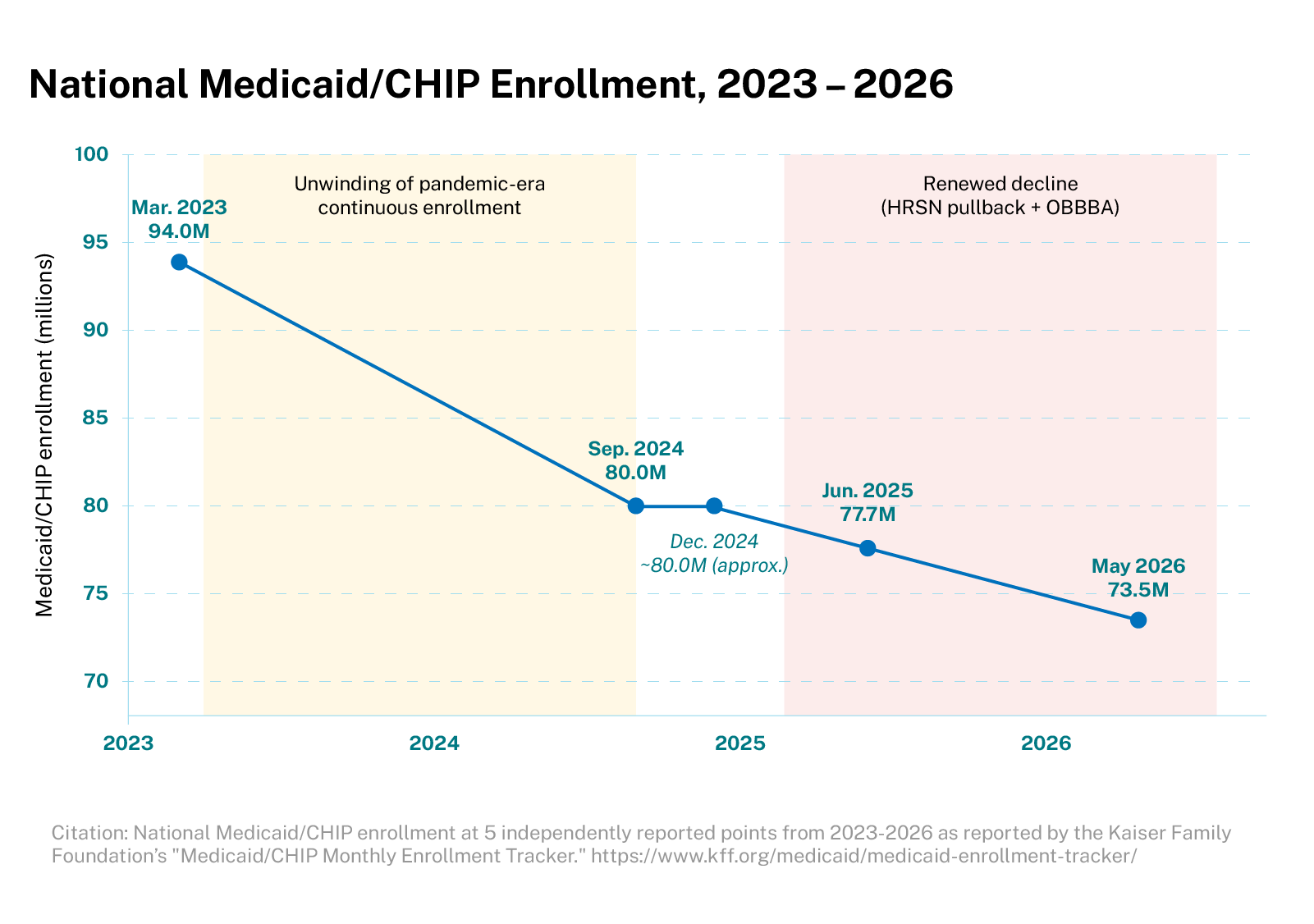
Urban Institute modeling projects 4.9 to 10.1 million fewer people will be enrolled in Medicaid expansion coverage by 2028, as a combined result of work requirements and more frequent redeterminations.4 National Medicaid and CHIP enrollment has already fallen by roughly 5 million people, or 6%, in the year ending May 2026.5 This is part of a longer slide which saw peak enrollment at 94 million in March 2023.6
The second shift at the federal level also took place in 2025, when the Centers for Medicare & Medicaid Services (CMS) rescinded it’s 2023–2024 guidance that had defined how states could use Medicaid to cover health-related social needs.7 Existing approvals weren't voided, but CMS now reviews new HRSN and health-equity oriented waiver requests case-by-case, rather than actively encouraging them.8 That's a meaningful federal pullback, but as North Carolina's experience below shows, it isn't the biggest threat to this work right now.
Why an equity investment's fragility isn't just federal
At the state level, North Carolina's Healthy Opportunities Pilots (HOP) is the clearest real-world test of the HRSN approach prior to the events described above. Medicaid pays directly for housing, food, and transportation, supports that state beneficiaries would otherwise go without. It's the program most often cited as proof the model works. A JAMA-published evaluation found it associated with lower Medicaid spending within 8 months of enrollment.9
A state-sponsored evaluation released in June 2026 put the savings at $164 per beneficiary per month, alongside fewer emergency department visits and hospitalizations.10 However, the program was shut down for more than a year when the North Carolina General Assembly declined to fund it starting July 1, 2025. It only restarted in mid-2026 with $25 million, well short of the $80 million the state had requested.11 This illustrates to state HHS leaders that the nearest-term threat to a proven equity investment can also come from the state's own budget cycle as easily as from Washington, D.C.
Provisional state involvement in the Rural Health Transformation Program
OBBBA also created a $50 billion Rural Health Transformation Program, meant to help states stabilize rural hospitals and modernize rural care delivery, distributed to all 50 states from FY2026 through FY2030.12
First-year awards include:
- Pennsylvania, $193.3 million
- New Jersey, $147.3 million
- New York, $212.1 million
- North Carolina, $213.0 million
- Missouri, $216.3 million
- Arizona, $167.0 million13
Missouri and North Carolina are both using a regional hub model to administer funds, while Pennsylvania is directing early dollars toward rural hospital sustainability.14 These funds cannot be used for Medicaid or Medicare reimbursement, or to replace existing federal, state, or local funding. They are restricted to new transformation activities like workforce, technology, and infrastructure investments.15
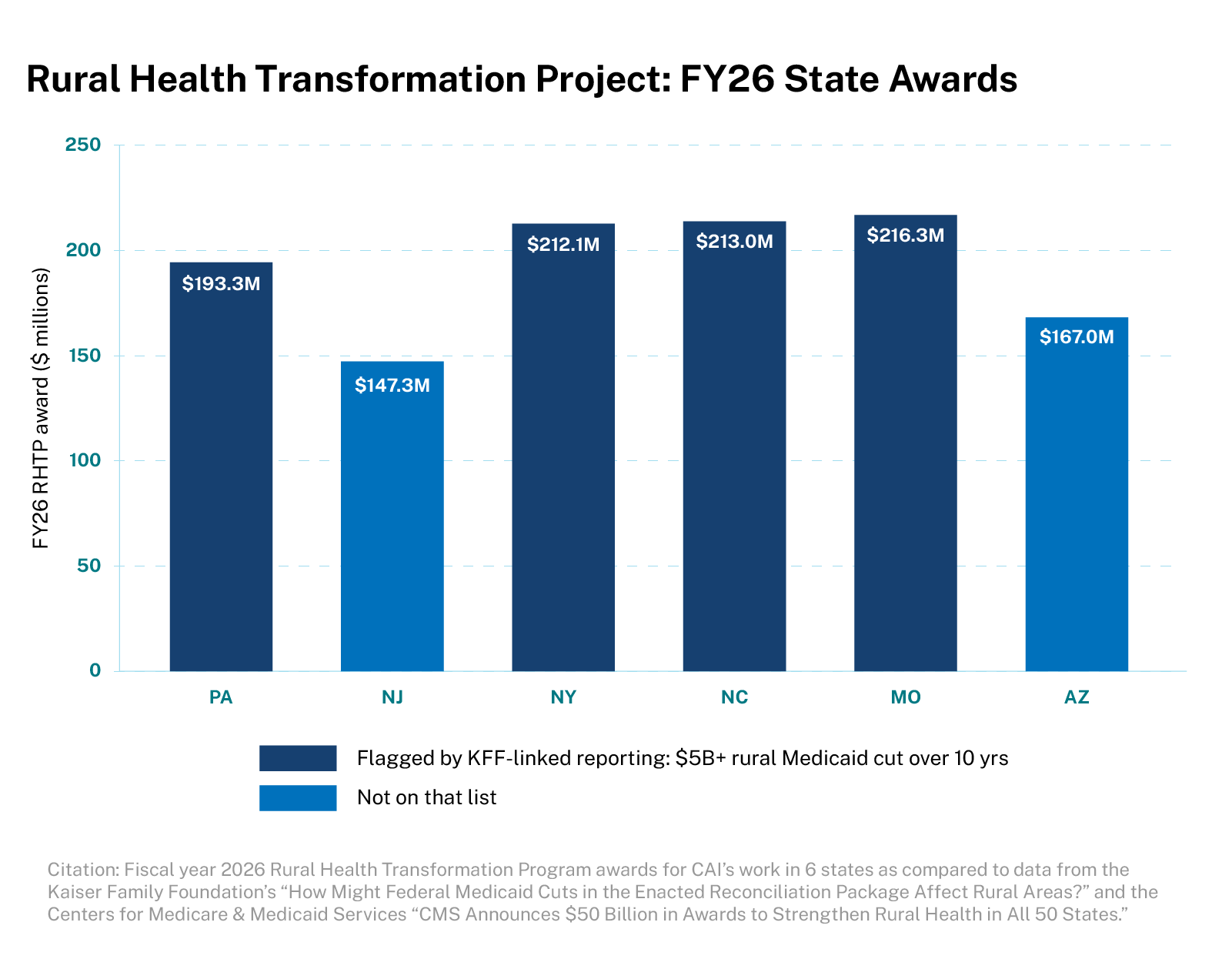
Pennsylvania, New York, North Carolina, and Missouri are each named in that reporting as likely to lose $5 billion or more in rural Medicaid funding over the 2025–2034 federal budget window, several times what any of them received in this first RHTP round.16 New Jersey and Arizona aren't on that list, likely reflecting smaller rural populations, so the fund may go proportionally further for those two states.
The Kaiser Family Foundation (KFF) estimates OBBBA's Medicaid provisions will cut roughly $137 billion from rural areas nationally over that same 2025–2034 window, nearly three times the size of the entire five-year Rural Health Transformation Program.17 The mismatch is sharper than the dollar figures alone suggest. The Congressional Budget Office (CBO) projects that more than three-quarters of the law's cuts and changes to Medicaid 2026 land in the final 5 years, 2030 through 2034, after RHTP funding has already run out. States that treat this fund as an offset for what they're losing elsewhere will likely be disappointed. States that treat it as one tool among several, tied to a specific rural strategy, are better positioned.
The compliance timeline varies more across these 6 states rather than operating under a single national deadline. New Jersey's Medicaid agency is already telling NJ FamilyCare members directly that new work requirements and eligibility changes to Medicaid 2026 take effect this fall, with a public-facing requirements checker already live.18 New York appears on CMS's June 2026 list of states with Section 1115 waiver enrollees also subject to the new rule, alongside Hawaii, Massachusetts, Oregon, and Utah. This indicates that New York is tracking the requirement on 2 separate eligibility pathways at once, not just the standard expansion group.19
Arizona adds a third pattern worth watching. The state resubmitted its own Arizona Health Care Cost Containment System (AHCCCS) Works work-requirement waiver to CMS in March 2025, months before OBBBA passed; reviving a program CMS had approved in 2019 but rescinded in 2021.20 At the same time, Arizona's Medicaid agency is running an approved Housing and Health Opportunities waiver, an HRSN program covering housing supports through September 2027.21 This illustrates a dichotomy. The same state pushing hardest on work requirements is also mid-build on the kind of housing-focused equity program CMS has otherwise pulled back from. This serves as a reminder that a state’s posture on Medicaid doesn't always sort neatly into “equity” or “compliance” camps.
The operational reality for Medicaid 2026–2027
Laid end to end, the sequence behind this article compresses into about 22 months.
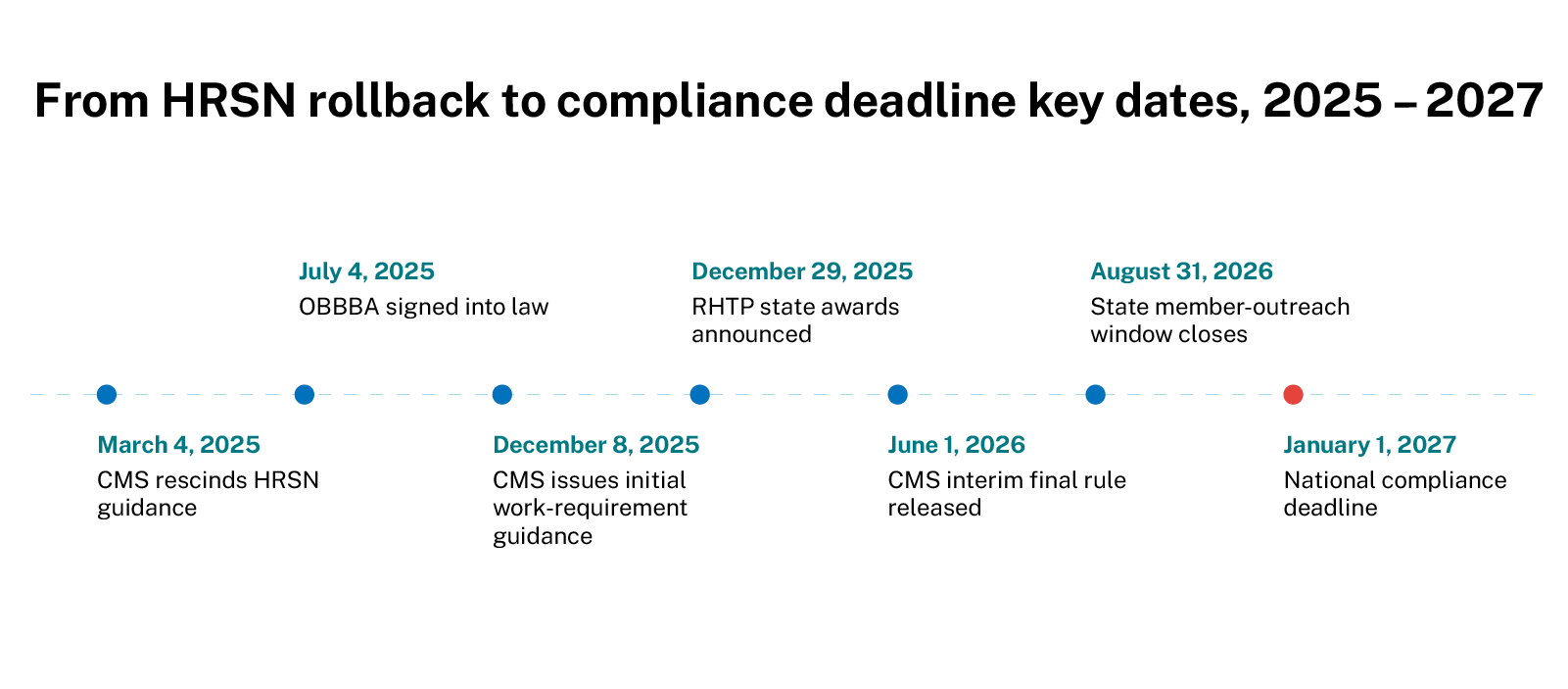
Most state HHS agencies now face a narrower operational question: Can existing systems verify work-hour compliance and complete a redetermination every 6 months—without wrongly dropping eligible people? Pennsylvania's Department of Human Services, for instance, must begin outreach to affected enrollees by September 2026 ahead of the January 2027 effective date, following CMS's interim final rule released June 1, 2026.22 OBBBA also bars states from contracting with Medicaid-managed care organizations to help determine beneficiary compliance, removing an outreach channel many states leaned on during the post-pandemic “unwinding.”23
This is where the equity risk really shows up. As evidenced from prior work-requirement waivers, it is likely that coverage losses will fall disproportionately on people who are working or exempt but have trouble navigating the reporting process. What it is not is people simply choosing to cease working.24 Outcomes are also likely to be decided through exemption-matching and data infrastructure.
Where this leaves state HHS agencies balancing Medicaid and health equity
Step back from the state-by-state detail, and the shape of the next 2 years is plain. CMS pulled back from encouraging Medicaid-funded equity work, then handed states a compliance mandate far larger than the funding offered to cushion its effects on rural areas. States are holding both halves of these changes to Medicaid 2026 at once, on a deadline that doesn't move.
North Carolina's experience is the clearest reminder that the nearer threat isn't always federal. It can be state legislature that undid years of proven results in a single budget cycle, faster than CMS could have rescinded the underlying waiver. The 6 reviewed states show there is no single playbook for managing this. Arizona is running a work-requirement push and an HRSN housing program at the same time; New Jersey, New York, Pennsylvania, North Carolina, and Missouri are each on a different compliance and funding timeline.
None of this makes the health equity mission futile, but it does change where the real work is. The next 2 years will be shaped by policy design and legislative footing, at least as much as by new benefits. This looks like exemption criteria and appeals processes precise enough to hold up to legal and legislative scrutiny, waiver renewals negotiated on CMS's new terms, and the kind of budget case North Carolina now has to make twice.
The right partner makes a difference helping states interpret CMS's rules and turn them into workable policy and state plan. It will be vital for a partner to have a working knowledge of what it takes to negotiate waiver and budget-neutrality submissions. Also of upmost importance is the ability to build the legislative and stakeholder case for funding programs that already prove out.
This is the most straightforward way to strike a balance between Medicaid shifts and mandates, along with health equity aspirations. CAI’s expansive work in both the technical systems demands of IT, and the more nuanced, consequential requirements of policy, brings a symmetry that can help states pursue closing health equity gaps in 2027.
To learn how CAI has helped state HHS agencies design policies and programs that address a variety of complex shifts in current landscape, complete the form below to discover more.
Endnotes
- Hinton, Elizabeth, Diana, Amaya, and Rudowitz, Robin. "A Closer Look at the Work Requirement Provisions in the 2025 Federal Budget Reconciliation Law." Kaiser Family Foundation, July 30, 2025. https://www.kff.org/medicaid/a-closer-look-at-the-work-requirement-provisions-in-the-2025-federal-budget-reconciliation-law/. ↩
- "Tracking Implementation of the 2025 Reconciliation Law: Medicaid Work Requirements." Kaiser Family Foundation, September 29, 2026. https://www.kff.org/medicaid/medicaid-work-requirements-tracker-overview/. ↩
- Buettgens, Matthew, Karpman, Michael, Haley, Jennifer M., Carter, Jameson, and Kenney, Genevieve M. "Projected Reductions in Medicaid Expansion Enrollment Under OBBBA's Work Requirements and Six-Month Redeterminations." Urban Institute, March 25, 2026. https://www.urban.org/research/publication/projected-reductions-medicaid-expansion-enrollment-under-obbbas-work. ↩
- Buettgens et al., “Projected Reductions in Medicaid Expansion Enrollment.” https://www.urban.org/research/publication/projected-reductions-medicaid-expansion-enrollment-under-obbbas-work. ↩
- "Medicaid/CHIP Monthly Enrollment Tracker." Kaiser Family Foundation, September 25, 2026. https://www.kff.org/medicaid/medicaid-enrollment-tracker/. ↩
- "Medicaid/CHIP Monthly Enrollment Tracker." https://www.kff.org/medicaid/medicaid-enrollment-tracker/. ↩
- "Medicaid Waiver Tracker: Approved and Pending Section 1115 Waivers by State." Kaiser Family Foundation, September 30, 2026. https://www.kff.org/medicaid/medicaid-waiver-tracker-approved-and-pending-section-1115-waivers-by-state/. ↩
- "Medicaid Waiver Tracker." https://www.kff.org/medicaid/medicaid-waiver-tracker-approved-and-pending-section-1115-waivers-by-state/. ↩
- Berkowitz, Seth A., Archibald, Jessica, and Yu, Zhitong, et al. "Medicaid Spending and Health-Related Social Needs in the North Carolina Healthy Opportunities Pilots Program." JAMA, February 27, 2025. https://jamanetwork.com/journals/jama/fullarticle/2830892. ↩
- "Healthy Opportunities Pilots Lead to Healthier Outcomes and Reduce NC Medicaid Costs." North Carolina Department of Health and Human Services, June 2, 2026. https://www.ncdhhs.gov/news/press-releases/2026/06/02/healthy-opportunities-pilots-lead-healthier-outcomes-and-reduce-nc-medicaid-costs. ↩
- Williams, Elizabeth, Mudumala, Anna, Hinton, Elizabeth, and Rudowitz, Robint. "Medicaid Enrollment & Spending Growth: FY 2025 & 2026." Kaiser Family Foundation, November 13, 2025. https://www.kff.org/medicaid/medicaid-enrollment-spending-growth-fy-2025-2026/. ↩
- "CMS Announces $50 Billion in Awards to Strengthen Rural Health in All 50 States." CMS, Dec. 29, 2025. https://www.cms.gov/newsroom/press-releases/cms-announces-50-billion-awards-strengthen-rural-health-all-50-states. ↩
- “CMS Announces $50 Billion in Awards.” https://www.cms.gov/newsroom/press-releases/cms-announces-50-billion-awards-strengthen-rural-health-all-50-states. ↩
- "May 2026: State Implementation of the Rural Health Transformation Program Ramps Up." State Health & Value Strategies, June 11, 2026. https://shvs.org/resources/may-2026-state-implementation-of-the-rural-health-transformation-program-ramps-up/. ↩
- "Rural Health Transformation Program Next Steps: Frequently Asked Questions." U.S. Chamber of Commerce, December 29, 2025. https://www.uschamber.com/health-care/rural-health-transformation-program-next-steps-frequently-asked-questions. ↩
- Saunders, Heather, Burns, Alice, and Levinson, Zachary. "How Might Federal Medicaid Cuts in the Enacted Reconciliation Package Affect Rural Areas?" Kaiser Family Foundation, July 24, 2025. https://www.kff.org/medicaid/how-might-federal-medicaid-cuts-in-the-enacted-reconciliation-package-affect-rural-areas/. ↩
- Saunders, Burns, and Levinson, “How Might Federal Medicaid Cuts Affect Rural Areas?” https://www.kff.org/medicaid/how-might-federal-medicaid-cuts-in-the-enacted-reconciliation-package-affect-rural-areas/. ↩
- “Community Engagement / Work Requirements.” New Jersey Division of Medical Assistance and Health Services. https://www.nj.gov/humanservices/dmahs/obbba/work-requirements/. ↩
- “Tracking Implementation of the 2025 Reconciliation Law.” https://www.kff.org/medicaid/medicaid-work-requirements-tracker-overview/. ↩
- "AHCCCS Works Waiver Amendment Request." Arizona Health Care Cost Containment System (AHCCCS), April 2025. https://www.azahcccs.gov/Resources/Federal/ahcccsworks1115waiver.html. ↩
- “Arizona Section 1115 Demonstration Extension.” Arizona Health Care Cost Containment System (AHCCCS), effective Oct. 14, 2022–Sept. 30, 2027. https://www.azahcccs.gov/Resources/Downloads/Federal/AHCCCS_ExtensionSTCs_Final10142022.pdf. ↩
- "An Update on Medicaid Work Requirements: What the Interim Final Rule Means for Pennsylvania." Pennsylvania Health Law Project, June 19, 2026. https://www.phlp.org/en/news/an-update-on-medicaid-work-requirements-what-the-interim-final-rule-means-for-pennsylvania. ↩
- "New Medicaid Work Requirements: How Managed Care Plans Can Help." National Health Law Program, September 24, 2025. https://healthlaw.org/new-medicaid-work-requirements-how-managed-care-plans-can-help/. ↩
- Buettgens et al., “Projected Reductions in Medicaid Expansion Enrollment.” https://www.urban.org/research/publication/projected-reductions-medicaid-expansion-enrollment-under-obbbas-work. ↩